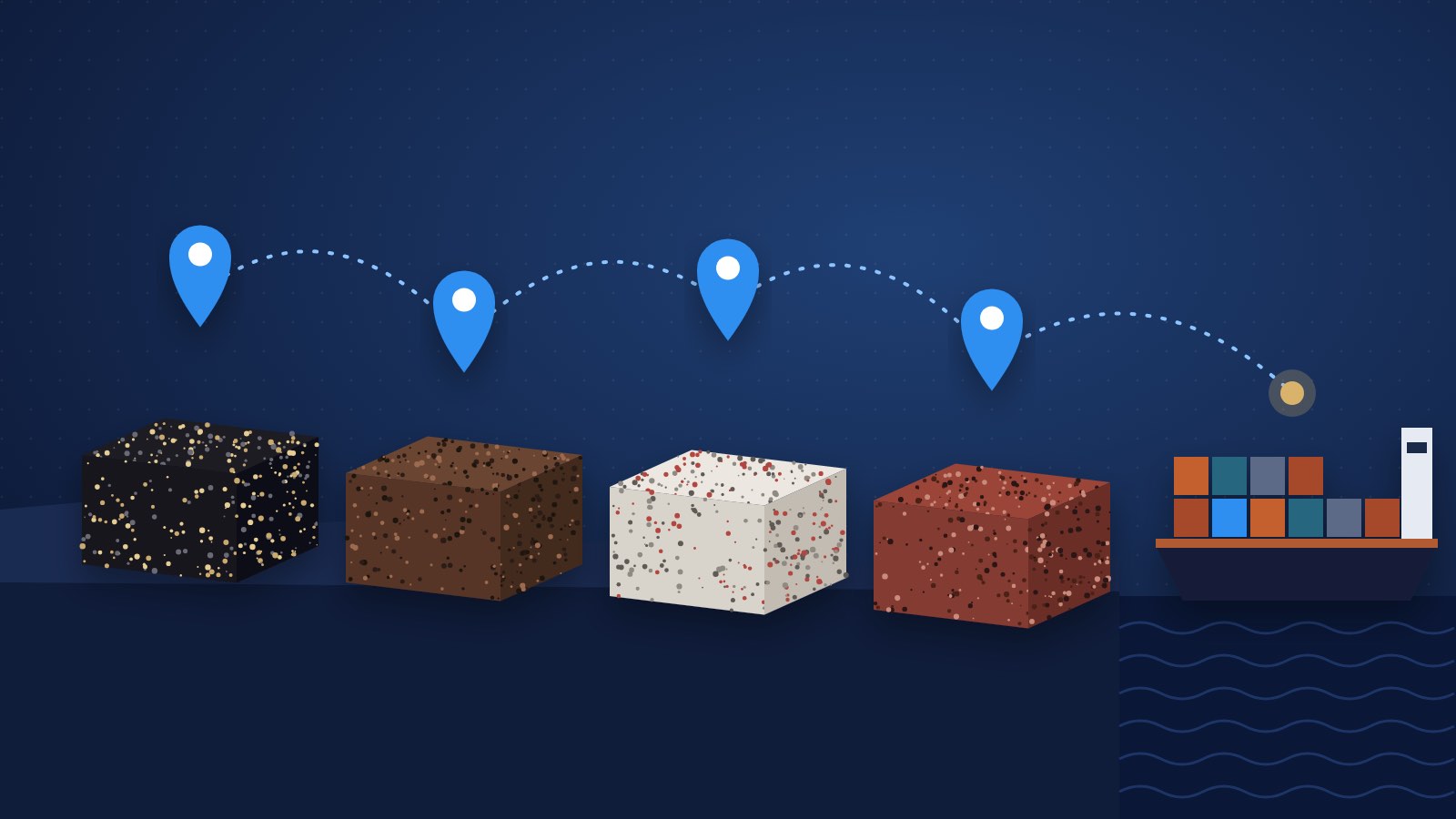

Every processor knows that yield matters. Fewer can say exactly how they calculate it, and even fewer calculate it the same way every time. One supervisor divides slab area by the volume on the purchase invoice, another uses the volume measured at the gate, and a third quotes "what this material usually gives". The numbers end up in the same register, but they are not comparable.
This guide sets out a clear, repeatable method for block to slab yield calculation: what yield means, how to measure the block, how many slabs a block can give, how to convert the result to square feet per CBM, and how to express wastage. Every example below uses round metric numbers so you can follow the arithmetic and check it yourself.
If you just want the answer for a specific block, use our free block yield calculator. If you want to understand what sits behind the number, read on.
What yield (recovery) actually means
Yield, often called recovery, is the saleable slab area a block produces per unit of block volume. In metric units it is expressed in square metres of slab per cubic metre of block (m²/m³). In India it is usually quoted in square feet per CBM.
Two words in that definition do a lot of work:
- Saleable. Only slab area you can actually sell counts. Broken slabs, rejected slabs and trimmed edges do not.
- Block volume. You need to decide which volume you are dividing by. Gross volume and net volume give different answers, and mixing them is the most common reason yield figures disagree.
Yield is always tied to a slab thickness. A block cut into 20 mm slabs gives more square metres than the same block cut into 30 mm slabs, so a yield figure without a thickness next to it is incomplete.
Step 1: measure the block (gross vs net volume)
Gross volume
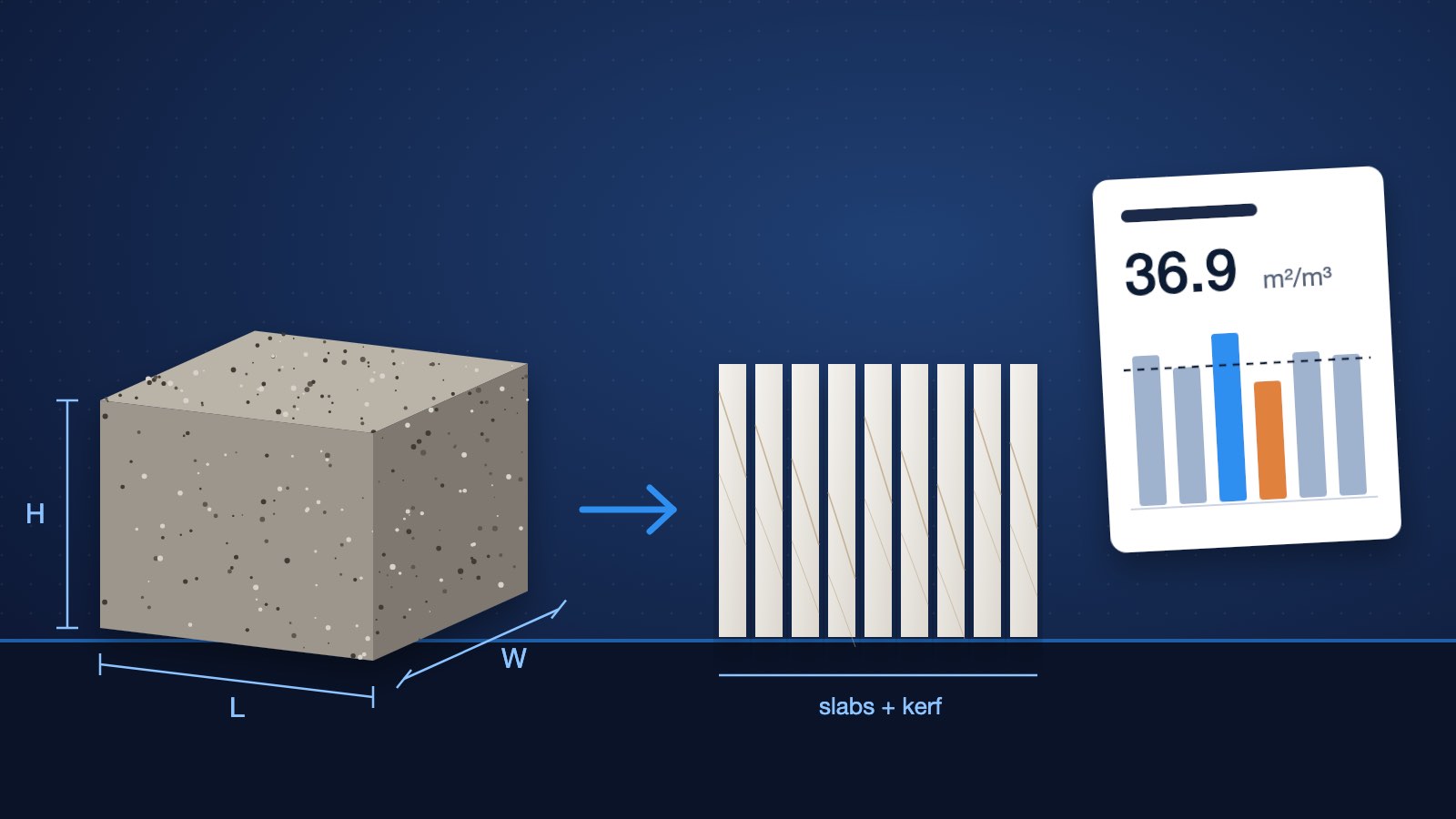
Gross volume is the simple box measurement: length × width × height, taken at the widest points.
For a block measuring 3.0 m × 1.8 m × 1.6 m:
Gross volume = 3.0 × 1.8 × 1.6 = 8.64 m³
Gross volume is often the basis for buying and selling blocks, but it overstates how much stone you can actually cut, because quarry blocks are rarely perfect rectangles.
Net volume
Net volume is the usable rectangular volume left after deducting for irregular faces, rounded corners, bumps, open cracks and the rough outer faces that will come off as skins. Yards make these deductions in different ways. Some measure the block at its narrowest points, some deduct a fixed allowance per face, and some measure the inscribed rectangle the saw will actually see.
The method matters less than applying it consistently. In our example, suppose the team deducts 10 cm from the length, 10 cm from the width and 10 cm from the height for irregular faces:
Net volume = 2.9 × 1.7 × 1.5 = 7.395 m³
That is about 14% less than the gross figure (7.395 ÷ 8.64 = 0.856). Whichever base you choose, write it down next to every yield figure.
Step 2: work out how many slabs the block gives
Each slab uses its own thickness plus the kerf, the width of stone the blade or wire removes as it cuts. So the number of slabs is approximately:
Slabs ≈ cutting dimension ÷ (slab thickness + kerf)
The cutting dimension (often called the cutting height) is the side of the block measured at right angles to the slab faces. Always round the result down, because you cannot sell part of a slab.
Kerf depends on the machine, the blades or wire, and their condition, so measure it on your own machines. For the examples below we assume, for example, a gang saw blade kerf of 5 mm and a diamond wire kerf of 7 mm. Gang saw blade kerf is typically a few millimetres, and diamond wire is often somewhere around 6 to 8 mm, but treat these as illustrative assumptions, not standards.
In our example the block sits on the saw so that each slab face is 2.9 m × 1.7 m (net) and the blades cut through the 1.5 m (1,500 mm) side.
- Slab face area (net) = 2.9 × 1.7 = 4.93 m²
Case A: 20 mm slabs on a gang saw (5 mm kerf)
- Thickness + kerf = 20 + 5 = 25 mm
- Slabs = 1,500 ÷ 25 = 60 slabs
- Area as cut = 60 × 4.93 = 295.8 m²
Case B: 30 mm slabs on a gang saw (5 mm kerf)
- Thickness + kerf = 30 + 5 = 35 mm
- Slabs = 1,500 ÷ 35 = 42.86, rounded down to 42 slabs
- Area as cut = 42 × 4.93 = 207.06 m²
The same block with a 7 mm diamond wire kerf
| Thickness | Thickness + kerf | 1,500 mm ÷ pitch | Slabs | Area as cut |
|---|---|---|---|---|
| 20 mm | 27 mm | 55.56 | 55 | 271.15 m² |
| 30 mm | 37 mm | 40.54 | 40 | 197.20 m² |
Notice how much kerf matters at thin gauges. With a 5 mm kerf on 20 mm slabs, 5 mm of every 25 mm (20%) of the cutting dimension turns into slurry. At 30 mm, the same kerf takes 5 mm of every 35 mm (about 14.3%).
Step 3: from area as cut to saleable area
Slabs coming off the saw are not yet saleable. Two things usually reduce the area:
- Edge trimming. Slabs are squared or trimmed to remove rough edges. In our example, suppose each slab is trimmed from 2.90 × 1.70 m to 2.85 × 1.65 m = 4.7025 m².
- Breakage and rejection. Some slabs crack during cutting, handling, resin or polishing, or fail inspection.
Case A (20 mm): 60 slabs cut, 2 rejected, 58 saleable. Saleable area = 58 × 4.7025 = 272.745 m²
Case B (30 mm): 42 slabs cut, 1 rejected, 41 saleable. Saleable area = 41 × 4.7025 = 192.8025 m²
Step 4: the yield formula
Yield (m²/m³) = total saleable slab area (m²) ÷ net block volume (m³)
Case A (20 mm): 272.745 ÷ 7.395 = 36.88 m²/m³
Case B (30 mm): 192.8025 ÷ 7.395 = 26.07 m²/m³
To show why the volume base matters: if you divided Case A's saleable area by the gross volume instead, you would get 272.745 ÷ 8.64 = 31.57 m²/m³. Same block, same slabs, a very different number. Neither is wrong, but you cannot compare one with the other.
Step 5: converting to sq ft per CBM
Indian processors and buyers usually talk in square feet per cubic metre (CBM). The conversion is a single multiplication:
1 m² = 10.7639 sq ft, so sq ft per CBM = yield in m²/m³ × 10.7639
- Case A (20 mm): 36.88 × 10.7639 = 397.0 sq ft per CBM (saleable area 272.745 m² = 2,935.8 sq ft)
- Case B (30 mm): 26.07 × 10.7639 = 280.6 sq ft per CBM (saleable area 192.80 m² = 2,075.3 sq ft)
Some yards also measure blocks in cubic feet. Since 1 m³ = 35.3147 cu ft, yield in sq ft per cu ft = m²/m³ × 0.3048. For Case A that is 36.88 × 0.3048 = about 11.24 sq ft per cu ft.
For more on how Indian granite factories record blocks and slabs, see our page on granite ERP for India.
Step 6: wastage percentage
Yield tells you what you got. Wastage tells you what you lost compared with the best possible result.
The theoretical maximum area is what the net block would give if every millimetre became saleable slab: no kerf, no trimming, no breakage.
Theoretical maximum area = net block volume ÷ slab thickness (in metres)
Wastage % = (1 − saleable area ÷ theoretical maximum area) × 100
- Case A (20 mm): maximum = 7.395 ÷ 0.020 = 369.75 m². Wastage = 1 − (272.745 ÷ 369.75) = 1 − 0.7376 = 26.2%
- Case B (30 mm): maximum = 7.395 ÷ 0.030 = 246.5 m². Wastage = 1 − (192.8025 ÷ 246.5) = 1 − 0.7822 = 21.8%
A useful shortcut: the theoretical maximum yield is simply 1 ÷ thickness. That is 50 m²/m³ at 20 mm and 33.33 m²/m³ at 30 mm. Your actual yield divided by that ceiling gives the same recovery ratio.
Note that the 20 mm case produces more saleable area but shows higher wastage, mostly because kerf takes a bigger share of each cut. Wastage % is a diagnostic, not a target on its own. The commercial decision depends on which thickness your customers want and at what price.
What drives wastage
Every block loses stone somewhere. The main causes are:
- Block shape. Irregular, wedge-shaped or rounded blocks lose more volume when squared to a cuttable rectangle.
- Cracks, veins and defects. Natural flaws cause breakage or force slabs to be downgraded or rejected.
- Thickness choice. Thinner slabs mean more cuts, so kerf takes a larger share of the block.
- Kerf. Blade and wire width, plus wear and tension, decide how much stone turns into slurry.
- Edge trimming. Generous trimming makes neat slabs but reduces area on every one of them.
- Breakage. Slabs crack during cutting, lifting, transport between stages and polishing.
- Rework. Resin, patching and re-polishing can save a slab, but a failed repair still ends as a reject.
Most of these are invisible in a monthly total. They only show up when each block is followed from the gate to the yard.
Why measure yield per block and per quarry
A monthly average yield hides almost everything useful. If one block from a good quarry gave excellent recovery and one from a cracked bench gave poor recovery, the average looks acceptable and tells you nothing about either.
Measuring yield per block lets you:
- Compare blocks from different quarries and suppliers on the same basis, so purchasing is based on results rather than habit.
- Check whether the price paid per CBM made sense once you know the square metres you actually sold.
- Spot machines or settings that consistently produce more breakage or thicker kerf.
- See whether a thickness decision paid off on a particular material.
- Feed real numbers into cost per square metre or square foot before quoting, not after.
Grouping per-block results by quarry then turns individual measurements into buying knowledge. This is the core of the case we made in why stone processors should digitize: yield guessed from averages cannot guide decisions, while yield measured per block can. If you run a granite factory, our granite processing page shows how this fits into the wider production flow.
Formula summary
| What | Formula | Example (Case A, 20 mm) |
|---|---|---|
| Gross volume | L × W × H | 3.0 × 1.8 × 1.6 = 8.64 m³ |
| Net volume | L × W × H after deductions | 2.9 × 1.7 × 1.5 = 7.395 m³ |
| Slabs per block | Cutting dimension ÷ (thickness + kerf), rounded down | 1,500 ÷ 25 = 60 |
| Saleable area | Saleable slabs × trimmed slab area | 58 × 4.7025 = 272.745 m² |
| Yield | Saleable area ÷ net volume | 272.745 ÷ 7.395 = 36.88 m²/m³ |
| Sq ft per CBM | Yield × 10.7639 | 36.88 × 10.7639 = 397.0 |
| Theoretical maximum area | Net volume ÷ thickness (m) | 7.395 ÷ 0.020 = 369.75 m² |
| Wastage % | (1 − saleable ÷ theoretical maximum) × 100 | 26.2% |
A few practical tips
- Agree one measuring method for net volume and train everyone at the gate to use it.
- Record the base (gross or net) and the thickness with every yield figure.
- Measure your own kerf periodically instead of relying on a number from the machine brochure.
- Count rejects at every stage, not only at final inspection, so you know where losses happen.
- Calculate before cutting to compare thickness options, then check after cutting against the real result.
You can run both checks in our free yield calculator: enter the block dimensions, deductions, thickness and kerf to see slabs per block, m²/m³, sq ft per CBM and wastage.
How Know-Now handles yield
Know-Now is the operating system built for stone processors. Each block is recorded at the gate with its quarry, supplier, dimensions and grade, and every slab cut from it stays linked to that block through cutting, resin, polishing and inspection. Yield per block, per material and per quarry is calculated automatically from gate to slab, with no spreadsheet to maintain. See how Know-Now works for stone processors, or book a demo to walk through your own factory's numbers.