
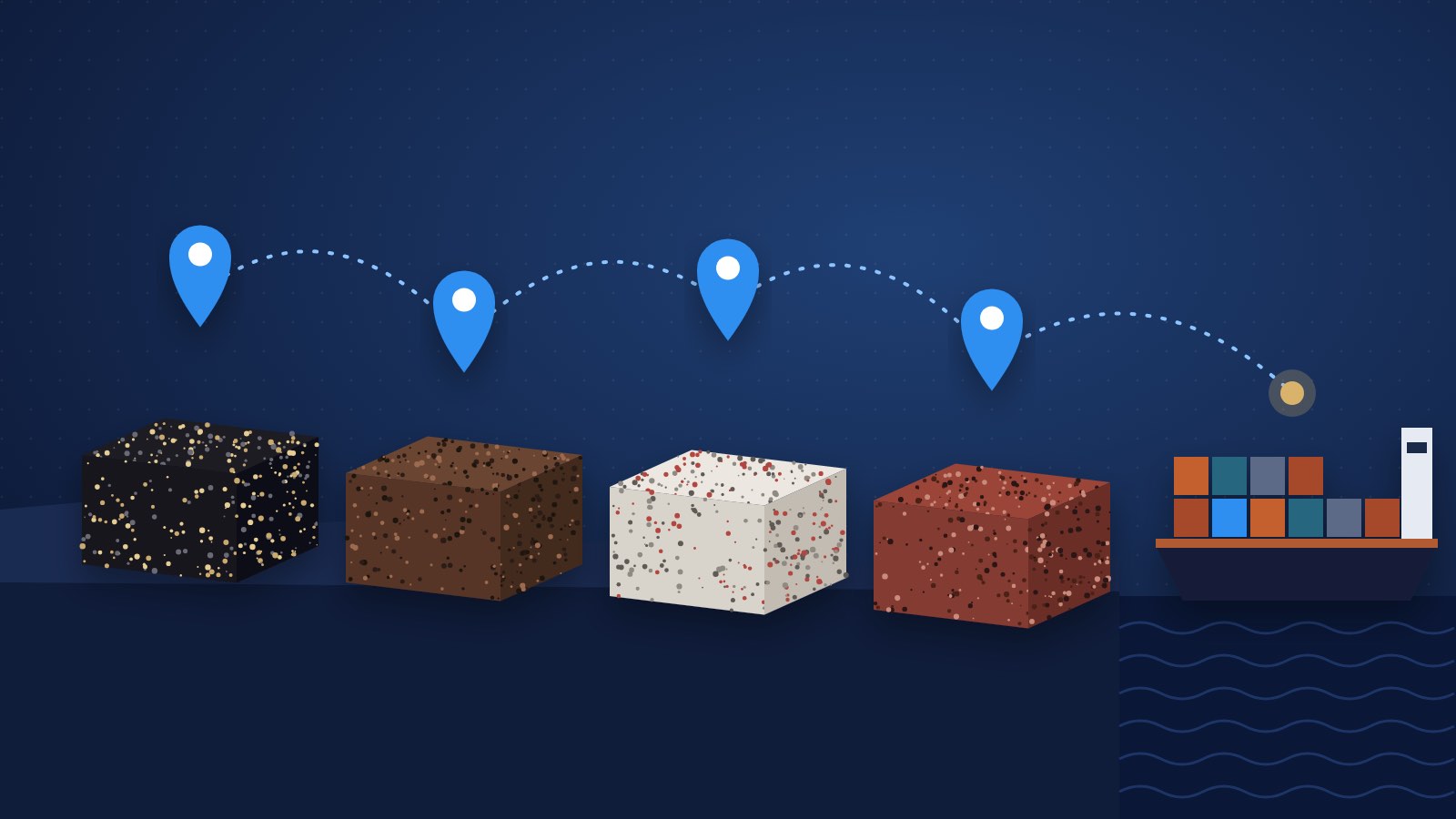
Ask a buyer in Europe or the US where Indian granite comes from and the answer is usually "South India." Ask a factory owner in Ongole or Khammam and you will hear the name of a village, a quarry owner, and a colour. Both are right. Indian granite is not one industry but a set of regional clusters, each with its own stone, its own way of working, and its own route to the sea.
This guide walks through the main granite producing and processing regions in India, the varieties each is known for, and the ports their stone usually leaves from. It is written for factory owners, exporters and buyers who want a clear picture of where material comes from and why that matters on the factory floor.
A note on sources: variety names in the granite trade are loose. The same stone is sold under several names, and one name can cover stone from more than one quarry. Where we link a variety to a region, we name the source. Where we could not confirm a link, we left it out.
Andhra Pradesh: Prakasam district, Chimakurthy and Ongole
Black Galaxy country
The best known Indian granite cluster is in Prakasam district. According to the Prakasam district administration, which lists Black Galaxy as the district's One District One Product, the stone is quarried in Chimakurthy mandal, in the villages of Chimakurthy, R.L. Puram, Budawada and Devarapalem. The same page traces the trade name to the late 1980s, when the first lease holder's successor began selling the stone as "Galaxy Granite."
The district page describes how the stone is graded in practice: by grain size (large or "popcorn," medium, and small), by background tone, and by veining, with grades from Q1 (no visible veining) to Q3 (two or more veins). It also notes that rough block prices are quoted per cubic metre and vary widely with size and quality. For a processor, that range is the whole story: two blocks of "Black Galaxy" can be very different purchases.
Where the stone is processed
Ongole, the district headquarters, is the main processing centre. A 2022 article in Litos reported more than 20 factories in Ongole handling big blocks and more than 60 handling small blocks, and said that big blocks are now rarely exported as rough. The Prakasam district page lists the main buyers of raw blocks as China, Taiwan, Egypt, Italy and Bangladesh, and of processed stone as the Middle East, the USA, Europe and North Africa.
Litos names Chennai and Krishnapatnam as the export ports for this stone, with Chennai the usual reference port for FOB prices.
Chittoor and Kurnool
Prakasam is not Andhra Pradesh's only granite belt. A March 2026 report in The Federal described the Madanapalle, Punganur and Kuppam belt in Chittoor district as the state's second largest granite cluster, naming Kuppam Green and Silver Waves among its varieties.
Further west, the erstwhile Kurnool district has a large polishing industry centred on Bethamcherla. A January 2025 report in The Hans India said finished slabs from these units travel in containers to Kakinada, Chennai and Krishnapatnam ports.
Telangana: Khammam, Karimnagar and Warangal
Telangana's granite industry is concentrated in three districts. As Telangana Today put it in 2021, "granite is a mainstream activity in Khammam, Karimnagar, Warangal districts of Telangana." The same article, quoting the Federation of Indian Granite and Stone Industry, said Rajasthan tops India's granite exporters, followed by Telangana and Andhra Pradesh together.
Karimnagar and the Tan Brown family
Karimnagar is the home of Tan Brown. Litos places the Tan Brown quarries in Karimnagar district and groups related browns, such as Sapphire Brown, Chocolate Brown and Coffee Brown, in the same family. It notes that slabs are produced by factories in Ongole, Hyderabad, Karimnagar, Chennai and Hosur, while block cutters near the quarries turn smaller blocks into tiles. That spread is typical of Indian granite: the quarry is in one district, but the gang saw can be hundreds of kilometres away.
Khammam and Warangal: Absolute Black
Khammam and Warangal are associated with black granite sold as Absolute Black. Trade guides such as Stone Galleria's Absolute Black guide list Khammam and Warangal among the main sources, with the Khammam stone also sold as "Khammam Black." The same guide makes a point every buyer should hear: Absolute Black has become a category name for black granite from many quarries, not a single stone. It lists other sources in Karnataka (Chamarajanagar, Kanakapura), Tamil Nadu (Pochampalli near Hosur, Salem, Tiruvannamalai) and Andhra Pradesh (Chittoor, Kanigiri).
Khammam's industry has been under pressure. The Hans India has reported factory closures in the district, which industrialists blamed on royalties and quarry lease rules.
Tamil Nadu: Krishnagiri, Hosur and the south
Krishnagiri and Hosur
The Krishnagiri district administration says the district takes its name from its black granite hillocks. It describes "Paradise" as the most popular multicoloured granite available in the district, notes that black granite is available in Hosur and Denkanikottai, and says the granite processing units that make finished slabs are mostly situated around Hosur. According to the district, multicoloured Paradise slabs are exported to America, England, Australia and other European countries.
Hosur's position matters: it sits close to Bengaluru and within reach of Chennai port, and Litos lists it among the centres where Telangana's Tan Brown is processed into slabs.
Kashmir White and other Tamil Nadu varieties
Kashmir White, despite the name, is not from Kashmir. Wikipedia describes it as stone found near Madurai in Tamil Nadu, and the Indian Bureau of Mines' granite review in the Indian Minerals Yearbook 2014 names Kashmir White, Jet Black, Tipu White and Paradiso among Tamil Nadu's granite varieties.
For many years Tuticorin was, alongside Chennai, a traditional export port for granite blocks from southern quarries. A 2013 report in Infrastructure Today noted that quarry owners from places such as Hospet, Bagalkot, Adoni and Ongole had started shipping through Krishnapatnam instead of their "traditional choice of Chennai and Tuticorin Ports."
Karnataka: Bengaluru, Chamarajanagar and Ilkal
Karnataka combines quarries spread across the state with a processing belt around Bengaluru. A November 2023 report from KNN India, datelined Bengaluru, quoted the Federation of Indian Granite and Stone Industry on unit closures "mainly in Jigani, Bommasandra and Attibele," all industrial areas on the southern side of the city. The same report noted that red granite from Ilkal was once much sought after.
On the quarry side, Chamarajanagar district is known for black granite. An April 2025 report in Maritime Gateway referred to around 50 black granite quarries in Chamarajanagar, said most of the state's quarry output is exported to Europe, the Middle East and the US, and described US bound containers of Karnataka granite piling up at Chennai port. The IBM's 2015 granite review lists Karnataka's specialities as Ruby Red, Chilly Red, Cera Grey, Kanakapura Multicolour, Himalayan Blue and Sira Grey.
Rajasthan: Jalore and other centres
Rajasthan works differently from the south. A 2012 overview in Litos described Jalore as the centre of the state's granite industry, with most quarries within about 300 km of the town and around 1,130 registered block cutters in Jalore as of July 2012. Modern gang saws were concentrated in Jalore and Udaipur. Varieties named in the article include Desert Brown, Desert Green (also called Splendour Green), Devgarh Black (also called Rajasthan Black), Rosy Pink, Lakha Red, Tiger Skin and others.
The same article said that, at the time, only a small share of Rajasthan's production was exported, with most stone sold in the domestic market, mainly Delhi and Gujarat. For the stone that is exported, trade guides such as XIMPEX name Mundra in Gujarat as the port for Rajasthan stone.
How operations differ across clusters
Put the clusters side by side and a few patterns stand out.
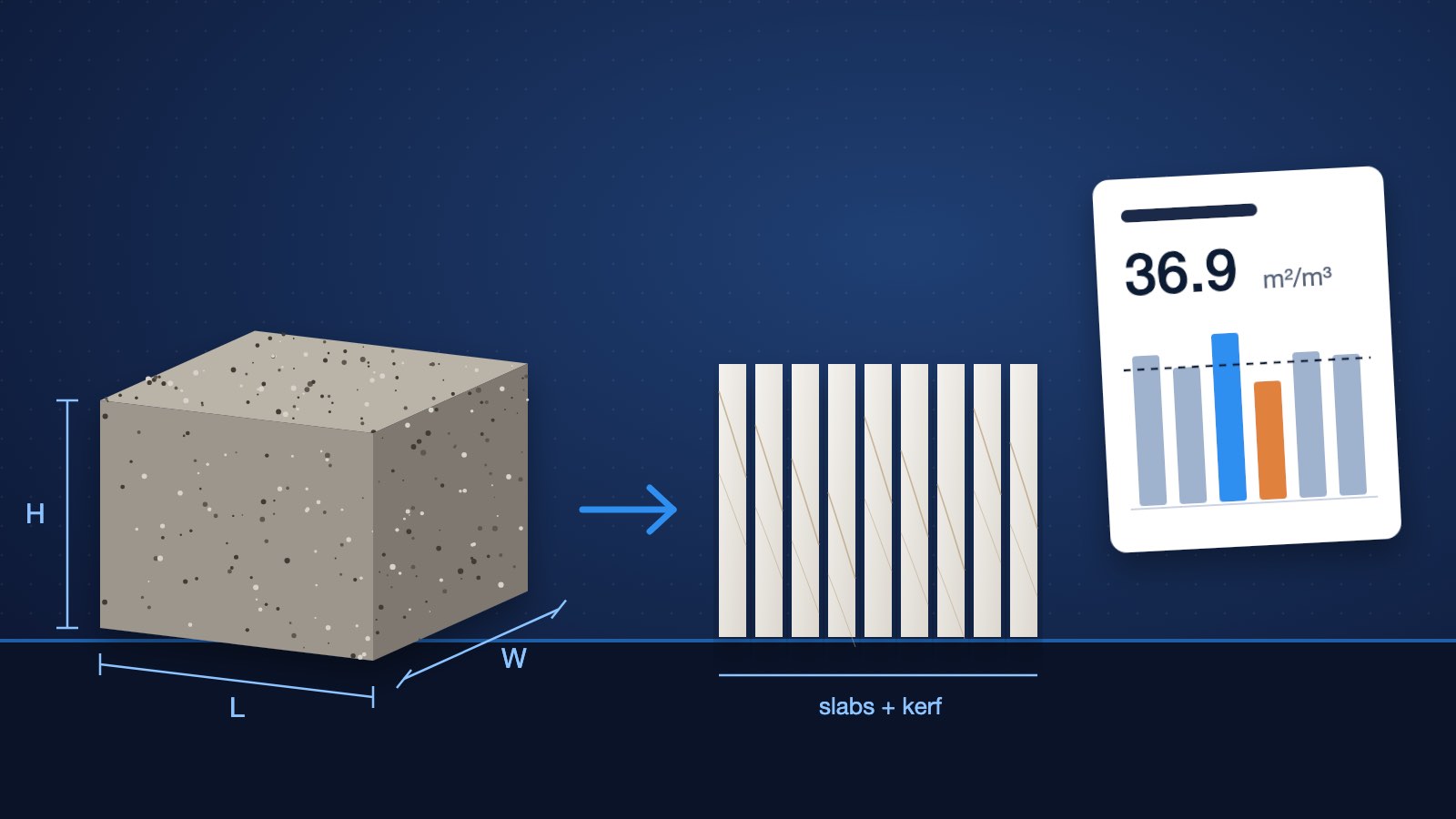
Blocks are bought by volume, slabs are sold by area. Rough blocks are priced per cubic metre, as the Prakasam district page shows. Finished slabs are sold by the square foot in India and often by the square metre abroad. The link between the two is recovery: how many square feet of saleable slab each CBM of block produces at a given thickness. That number is never fixed, which is why we wrote a separate guide on block to slab yield calculation and built a yield calculator.
Quarry and factory are often far apart. Tan Brown from Karimnagar is cut in Ongole, Hyderabad, Chennai and Hosur. Karnataka's stone is processed around Bengaluru. A single company may buy blocks from two or three clusters and run more than one unit. The paperwork has to travel with the block.
Processing style varies. Ongole has both large block factories and small block units. Rajasthan, at least as of 2012, ran largely on block cutters producing free size slabs and tiles, with a smaller number of gang saws. Each style produces different sizes, different waste, and different recovery.
Each cluster has its port. From the sources above: Chennai and Krishnapatnam for Prakasam stone; Kakinada, Chennai and Krishnapatnam for Kurnool's polished slabs; Chennai for Karnataka's containers; historically Tuticorin for southern blocks; and Mundra for Rajasthan. Shipping planning, container weights and documents differ by route.
Domestic and export run side by side. Prakasam sells raw blocks to China and finished slabs to the Middle East and the US, while also supplying Kerala, Karnataka, Maharashtra and other states. Most factories sell into both markets from the same yard.
Practical advice for granite factories and exporters
Record quarry and cluster on every block
A block's quarry is its most useful attribute after its size. Record quarry, cluster, supplier, colour name, grade, CBM and rate at the gate, with photos. Because trade names like Absolute Black cover stone from many places, the colour name alone tells you little. The quarry tells you what to expect.
Compare recovery by quarry, not by colour
When every block carries its quarry, you can compare actual recovery in sq ft per CBM by quarry and by supplier. That turns the purchase conversation from "this quarry always gives good recovery" into a number on the table. Over a season, it shows which quarries are worth a higher rate and which are not.
Keep domestic and export stock in one system
When export containers are planned in one sheet and domestic sales in another, the same slabs get promised twice. One stock register, with every bundle tagged by block, quarry, thickness, finish and location, lets the domestic sales team and the export desk see the same yard. It also makes container loading lists and packing lists faster to prepare. Our page for stone exporters covers that side in more detail.
Treat each unit as part of one business
If you run units in two clusters, or buy in Chimakurthy and cut in Hosur, keep one register across all of them. Transfers between units, block movements and costs should be visible from the office without a round of phone calls. See how this works on the granite processing page.
How Know-Now fits
Know-Now is a stone industry ERP built for how Indian granite actually moves: blocks bought by CBM from several quarry clusters, gang saw planning by thickness, recovery in sq ft per CBM by quarry, slab and bundle stock across more than one unit, and export containers alongside domestic sales. Read more on our granite ERP for India page, or book a demo to walk through your own blocks, units and ports.